-
Aug. 26, 2026 / LLM Hardware News
Xiaomi AI Cube Targets Local LLMs With 1.22 TB/s Near-Memory Bandwidth
Xiaomi has shown a prototype AI workstation called the Xiaomi AI Cube, a compact 150W system that combines three of the company’s XRING processors in one machine. For local LLM users, the headline number is 1.22 TB/s of bandwidth on the XRING O100 accelerator, alongside support for large local models and a system design built...

-
Aug. 17, 2026 / Featured
We Tested Qwen3.8 27B: How Much GPU and VRAM Do You Really Need?
Qwen3.8 27B is another model in the 27B class that looks particularly interesting for local inference. We wanted to find out what it actually takes to run it on consumer hardware, especially at longer context lengths. This article is based on our own llama.cpp benchmark results. We are not evaluating model intelligence, coding quality, or...

-
Aug. 12, 2026 / Hardware Insights
Muse Glimmer 30B Hardware Requirements and Benchmark Results
Meta’s Muse Glimmer 30B has been getting attention in local inference circles, and we wanted to know what it actually takes to run it on your own hardware. This article is not a review of the model’s reasoning or coding quality. We are strictly looking at hardware behavior. VRAM usage, context scaling, prompt processing speed,...

-
Aug. 7, 2026 / Hardware Insights
Is the 48 GB Mac Mini M4 Pro Good for Local LLMs?
If you want to stay in the Apple ecosystem and need a compact system for running local large language models, the Mac Mini with the M4 Pro and 48 GB of unified memory is currently the lowest configuration that makes practical sense. Apple also offers 24 GB versions of the Mac Mini, but they are...
-
Apr. 16, 2026 / Hardware Insights
What hardware you need for MiniMax-M2.7 230B (A10B) in 4-bit
Running MiniMax-M2.7 230B locally requires extreme VRAM, even with 4-bit quantization, and a dual high-end GPU setup is the practical baseline today. This article shows real VRAM usage and performance from a dual RTX Pro 6000 Blackwell system using MXFP4 quantization, with a focus on hardware limits and inference speed. Test setup and model details...

-
Apr. 7, 2026 / Hardware Insights
What GPU for Running OpenClaw Locally
Running OpenClaw locally is not the same as running a simple chat model. Once you move into agentic workflows with tool calling, long system prompts, and multi-step reasoning, the hardware requirements shift in a very specific way. VRAM becomes the primary constraint, memory bandwidth defines responsiveness, and model size directly affects reliability. This article focuses...
-
Apr. 5, 2026 / Local Agents
OpenClaw (local) — Hardware and LLM Overview
OpenClaw is a personal, self-hosted AI assistant platform designed to run on your own hardware while connecting to the communication tools you already use. Instead of being just a chat interface, it functions as an agent system—capable of reasoning, executing tasks, and interacting with software and services across multiple steps. A typical OpenClaw setup includes...

-
Apr. 3, 2026 / Hardware Insights
What Hardware for Gemma 4 26B and 31B LLM Local Use
The new Gemma 4 models from Google DeepMind have landed, and for local LLM users this is one of the more practical releases in a while. The lineup gives us two interesting mid-size targets: a 26B MoE model (A4B) and a 31B dense model. Both support up to 256K context, tool calling, and personal agent-style...
-
Apr. 2, 2026 / Hardware Insights
Best Laptop for Running OpenClaw AI Agent Locally
Running OpenClaw locally is very different from running a chat UI. If you have already read guides like Best Mini Computer for Running OpenClaw AI Agent and Understanding OpenClaw Hardware Requirements, you know the bottleneck is not just loading a model. It is sustaining long agent loops with tool calls, large context, and repeated prompt...
-
Mar. 31, 2026 / Hardware Insights
Best Mini Computer (PC/Mac) for Running OpenClaw AI Agent
Understanding OpenClaw Hardware Requirements OpenClaw is not a typical chat interface. It is an agentic system that continuously executes tools, runs shell commands, sets cron jobs, and manages files. This changes the hardware profile significantly. The main constraint is not just model size, but consistency. Agentic workflows require models that can follow tool calls, maintain...
-
Mar. 26, 2026 / LLM Hardware News
New Intel B70 GPU for local LLM: first benchmarks and RTX 3090 comparison
Intel is entering the local LLM space more seriously with the Arc B70, a 32 GB VRAM GPU aimed directly at inference workloads. The card is expected to release on April 2, with preorders already appearing on Newegg around the $949 mark. For local LLM users, this is one of the first sub-$1000 options with...
-
Mar. 24, 2026 / Hardware Insights
Your RTX Pro 6000 Blackwell Does Not Support FlashAttention-4
If you bought an RTX Pro 6000 Blackwell expecting full Blackwell support for local LLM inference, you will not get FlashAttention-4. That kernel only runs on datacenter Blackwell GPUs like NVIDIA B200 and on NVIDIA H100. Even though the branding says “Blackwell”, the underlying hardware is different in a way that directly affects inference performance....
-
Mar. 19, 2026 / Hardware Insights
This Desktop Machine Runs 1T Parameter LLMs Locally
The NVIDIA DGX Station built around the GB300 Grace Blackwell Ultra is not just another workstation with a big GPU. It is closer to a single-node inference server designed around one idea: remove the boundary between VRAM and system RAM while keeping GPU compute in control. You get 252 GB of HBM3e at 7.1 TB/s...
-
Mar. 4, 2026 / LLM Hardware News
M5 Pro and M5 Max Local LLM Users Get 4x Faster Prefill, But Modest Token Gains
Apple has officially introduced the M5 Pro and M5 Max. For most buyers this is another generational bump. For local LLM users, especially those running quantized 7B to 120B models on unified memory, this release is about two things: memory bandwidth and prompt processing. Apple is claiming up to 4x faster LLM prompt processing compared...

-
Feb. 26, 2026 / Hardware Insights
How Memory Chips Determine GPU Memory Bandwidth for Local LLM Inference
If you are running quantized LLMs locally, especially 4-bit models, memory bandwidth usually matters more than raw CUDA core count. Once the model fits in VRAM, inference speed is largely determined by how fast the GPU can stream weights from VRAM into the tensor cores. For 7B models this is less obvious. For 34B, 70B,...

-
Feb. 26, 2026 / Hardware Insights
Qwen3.5 27B and Qwen3.5 35B: What Hardware Do You Actually Need? (GPU Benchmarks Inside)
Qwen3.5 27B fits comfortably on a 24 GB GPU up to 131k context in 4-bit, but becomes memory heavy at 262k. Qwen3.5 35B MoE in 4-bit is the more practical long-context model for 24 GB cards, and it is significantly faster in token generation despite having more total parameters. VRAM is still the main constraint,...

-
Feb. 17, 2026 / LLM Hardware News
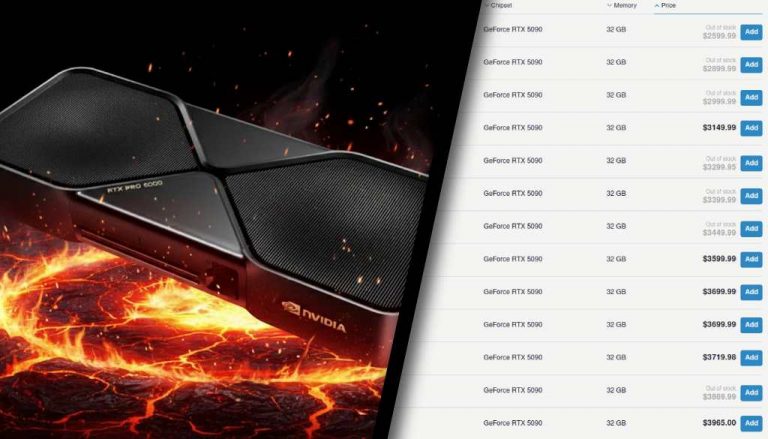
LLM GPUs for Local AI Builds Jump in Price Across All VRAM Tiers
If you run quantized LLMs locally, VRAM is your main constraint. 16GB is the practical entry point for 13B class models in 4-bit, and anything above 24GB opens the door to 70B with multi GPU setups. Between November 2025 and February 2026, pricing for 16GB and higher GPUs has moved sharply upward. This article focuses...

-
Feb. 16, 2026 / LLM Hardware News
Ditch the Mac Mini: PicoClaw and ZeroClaw Run OpenClaw on $10 Boards
The OpenClaw ecosystem just split into two new directions. A Go rewrite called PicoClaw and a Rust implementation called ZeroClaw both claim to run on $10 class hardware, including Raspberry Pi type boards. The Mac mini is no longer part of the story. For local LLM enthusiasts who followed the recent OpenClaw security controversy, this...

-
Feb. 15, 2026 / LLM Hardware News
llama.cpp Update Delivers Major Qwen3 Coder Next Token Speed Boost
A recent pull request to llama.cpp is delivering a measurable performance jump for recently released Qwen3 Coder Next, with tests showing a significant increase in both prompt processing and next token generation speeds. The largest gains are in token generation, which directly impacts real time coding and chat workflows. The changes come from a compute...

-
Feb. 6, 2026 / LLM Hardware News
Microsoft Maia 200 and the Quiet Shift Toward LLM Inference Silicon
Microsoft has joined Google and Amazon in the custom AI silicon race with Maia 200, its second-generation in-house accelerator focused on large language model inference. Following the earlier Maia 100, this iteration shows a clearer commitment to custom silicon as inference costs begin to dominate real-world AI deployments. Alongside Google’s TPU v7 and Amazon Trainium,...