
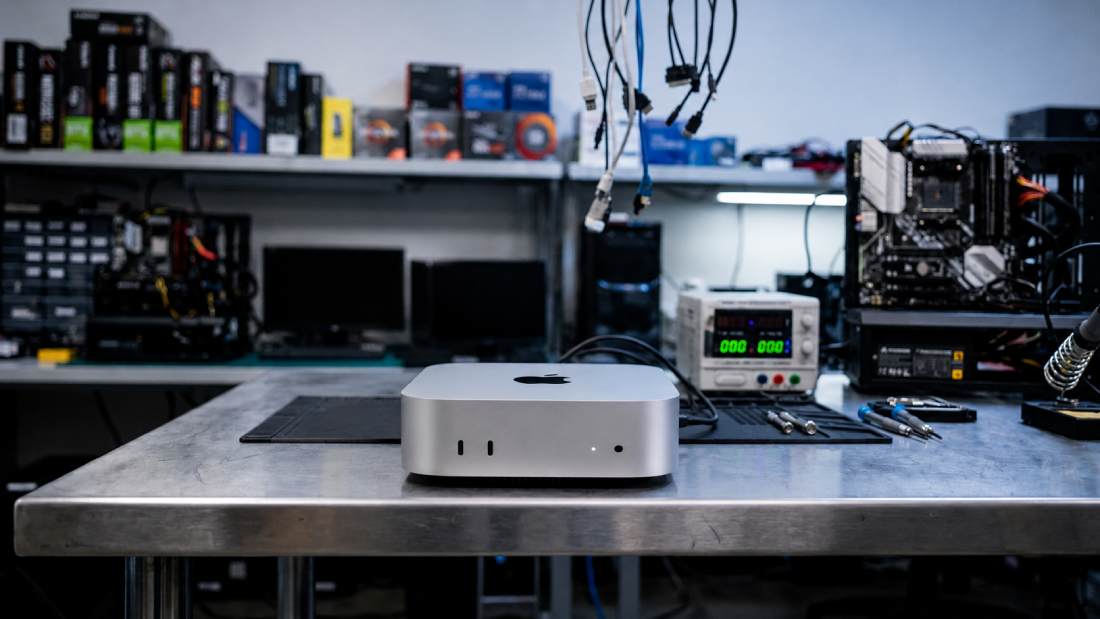
If you want to stay in the Apple ecosystem and need a compact system for running local large language models, the Mac Mini with the M4 Pro and 48 GB of unified memory is currently the lowest configuration that makes practical sense.
Apple also offers 24 GB versions of the Mac Mini, but they are difficult to recommend for local LLM use. Unified memory is shared between the CPU, GPU, operating system, and applications. In practice, a 24 GB system does not leave enough usable memory to comfortably run modern 27B and 35B class models, which are becoming the practical starting point for many local AI users.
A 48 GB configuration gives enough headroom to load larger 4-bit models while still leaving memory for macOS and other applications. It is not designed for the biggest 70B models, but it is capable of running many of today’s most popular reasoning, coding, and general-purpose models.
Mac Mini M4 Pro 48 GB specifications
The system tested uses the following configuration:
| Specification | Value |
|---|---|
| Chip | Apple M4 Pro |
| CPU | 14-core |
| GPU | 20-core |
| Unified Memory | 48 GB |
| Memory Bandwidth | 273 GB/s |
| Storage | 1 TB SSD |
| Price | $2,699 USD |
Memory bandwidth is one of the biggest strengths of Apple’s unified memory architecture. At 273 GB/s, the M4 Pro provides enough bandwidth to deliver excellent inference performance for models that fit into memory.
Local LLM benchmark methodology
Our benchmarks focus on real-world local inference rather than synthetic testing.
Every model was tested with multiple context lengths, including 64K context, to show how performance changes as conversations become longer. This provides a better representation of everyday use for coding, document analysis, and research tasks.
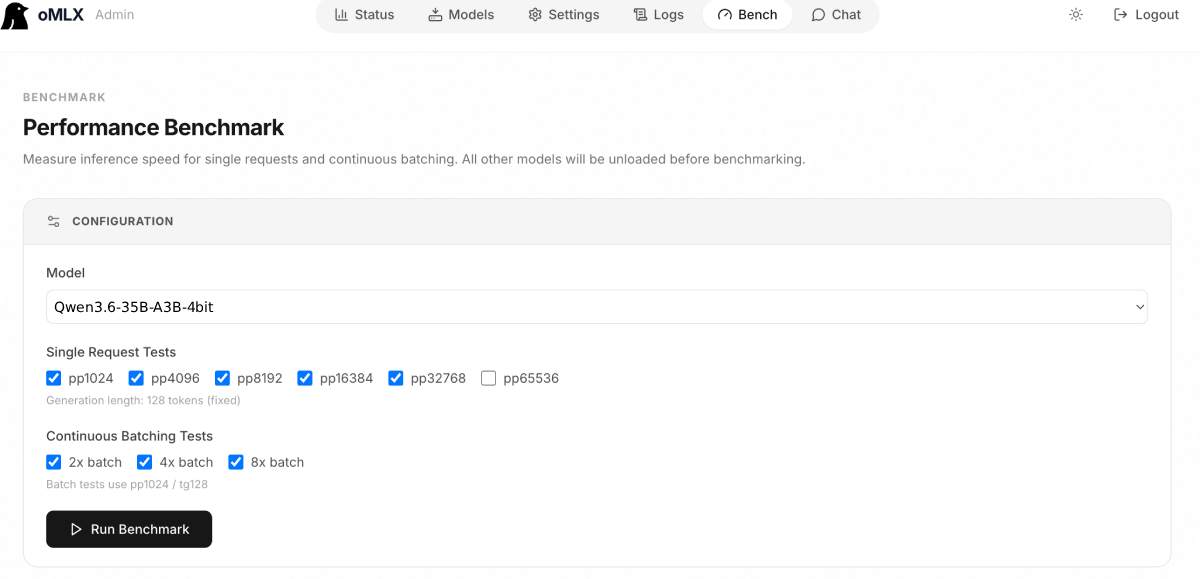
oMLX Performance Benchmark screen
For each benchmark we measured prompt processing speed (PP), token generation speed (TG), and calculated the approximate time to first token.
Lower values result in a more responsive user experience when working with large context windows.
Qwen3.6 35B A3B 4-bit benchmark
| Model | Quantization | Context | PP tok/s | TG tok/s | Time to First Token |
|---|---|---|---|---|---|
| Qwen3.6 35B A3B | 4-bit | 16K | 831.4 | 71.3 | 19.7 s |
| Qwen3.6 35B A3B | 4-bit | 32K | 689.2 | 60.4 | 47.6 s |
| Qwen3.6 35B A3B | 4-bit | 64K | 513.3 | 47.3 | 127.8 s |
This model performs very well on the M4 Pro. Prompt processing remains fast even with large context windows, while generation speed stays close to 50 tokens per second at 64K context. This makes it suitable for long conversations and document work.
Qwen3.6 27B 8-bit benchmark
| Model | Quantization | Context | PP tok/s | TG tok/s | Time to First Token |
|---|---|---|---|---|---|
| Qwen3.6-27B | 8-bit | 16K | 112.8 | 8.1 | 145.3 s |
| Qwen3.6-27B | 8-bit | 32K | 113.8 | 8.2 | 288.0 s |
| Qwen3.6-27B | 8-bit | 64K | 71.4 | 7.1 | 917.9 s |
Running an 8-bit model pushes memory usage much higher. While inference is still possible, prompt processing becomes significantly slower. Most users will likely prefer a 4-bit quantized model instead, as it provides a much better balance between quality and responsiveness.
Gemma 4 26B A4B benchmark
| Model | Quantization | Context | PP tok/s | TG tok/s | Time to First Token |
|---|---|---|---|---|---|
| Gemma 4 26B A4B | 4-bit | 16K | 673.5 | 48.4 | 24.3 s |
| Gemma 4 26B A4B | 4-bit | 32K | 532.1 | 52.3 | 61.6 s |
| Gemma 4 26B A4B | 4-bit | 64K | 422.7 | 36.3 | 155.1 s |
Gemma performs consistently across all tested context lengths. Even at 64K context, token generation remains above 36 tokens per second, making it a solid choice for interactive workloads.
GPT-OSS 20B benchmark
| Model | Quantization | Context | PP tok/s | TG tok/s | Time to First Token |
|---|---|---|---|---|---|
| GPT OSS 20B | 4-bit | 16K | 713.2 | 54.2 | 23.0 s |
| GPT OSS 20B | 4-bit | 32K | 582.2 | 42.7 | 56.3 s |
| GPT OSS 20B | 4-bit | 64K | 463.4 | 33.3 | 141.4 s |
GPT-OSS also performs well on the M4 Pro. Prompt processing scales predictably with larger contexts, while token generation remains responsive enough for interactive use.
Qwen3 Coder Next benchmark
| Model | Quantization | Context | PP tok/s | TG tok/s | Time to First Token |
|---|---|---|---|---|---|
| Qwen3 Coder Next | 4-bit | 16K | 612.3 | 51.3 | 26.8 s |
| Qwen3 Coder Next | 4-bit | 32K | 534.4 | 43.3 | 61.3 s |
| Qwen3 Coder Next | 4-bit | 64K | 417.4 | 33.3 | 157.0 s |
Qwen3 Coder Next delivers balanced performance for software development tasks. Both prompt processing and generation remain consistent as context size increases.
Is there a better value alternative?
If you are not committed to macOS, there is a strong alternative.
The GMKtec EVO-X2 based on the Ryzen AI MAX+ 395 offers 64 GB of unified memory and a 1 TB SSD for around $2,000. That is roughly $700 less than the tested Mac Mini while providing an additional 16 GB of memory.
Qwen3.6 35B A3B comparison
| System | RAM | Context | PP tok/s | TG tok/s |
|---|---|---|---|---|
| Mac Mini M4 Pro | 48 GB | 32K | 689.2 | 60.4 |
| Ryzen AI MAX+ 395 | 64 GB | 32K | 807.3 | 43.5 |
| Mac Mini M4 Pro | 48 GB | 64K | 513.3 | 47.3 |
| Ryzen AI MAX+ 395 | 64 GB | 64K | 547.7 | 38.5 |
The two systems are surprisingly close.
The Ryzen AI MAX+ 395 is slightly faster during prompt processing, especially with larger context windows. The Mac Mini responds with slightly higher token generation speeds, helped by its higher memory bandwidth.
The more significant difference is memory capacity. The Strix Halo system includes 64 GB of unified memory, giving it additional room for larger models and more flexibility for future workloads, while also costing about $700 less.
Conclusion
The Mac Mini M4 Pro with 48 GB of unified memory is the minimum Apple mini PC configuration that makes sense for serious local LLM use.
It offers excellent performance for today’s popular 20B to 35B class 4-bit models, very good memory bandwidth, low power consumption, and the advantages of the Apple ecosystem. If you specifically want macOS, it is a solid choice.
However, if your priority is getting the best performance per dollar, a Strix Halo mini PC with 64 GB of memory currently offers better overall value. It costs less, includes more memory, and delivers comparable inference performance, making it the stronger option for users focused purely on running local LLMs.