
Huawei’s Atlas 300I Duo offers 96GB VRAM for local LLMs under $1500. Is this the budget VRAM breakthrough?
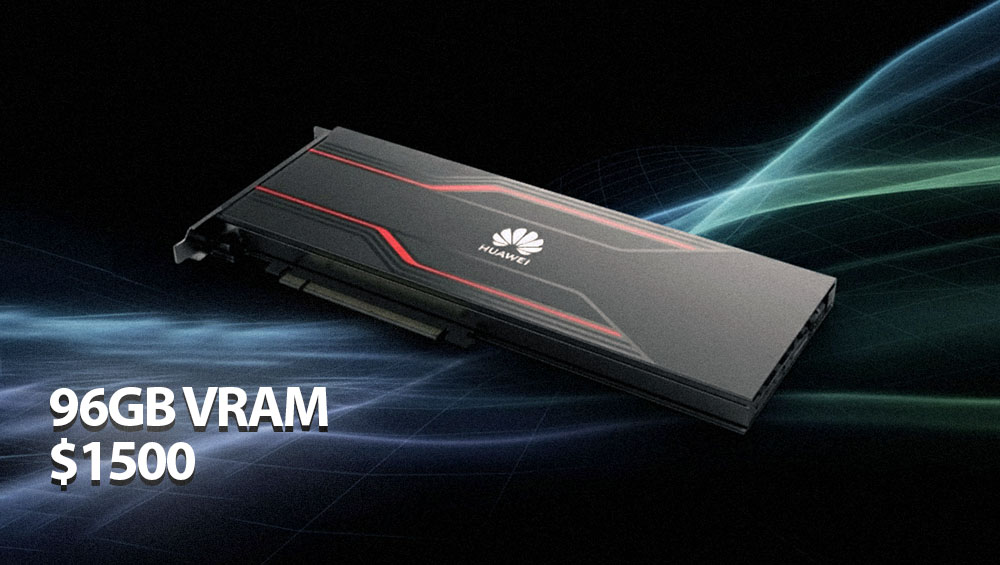
For local LLM enthusiasts, VRAM has always been the main constraint when choosing hardware. Now, a new option is becoming more accessible at a price point that’s hard to ignore. The Huawei Atlas 300I Duo, an AI inference card from China, is showing up on platforms like Alibaba for under $1500, offering an impressive 96 GB of VRAM. While it isn’t designed to compete head-to-head with Nvidia’s high-end GPUs in raw speed, its unique specifications make it an appealing choice for anyone prioritizing model capacity over generation throughput.
A Deep Dive into the Huawei Atlas 300I Duo’s Hardware
The specifications of the Atlas 300I Duo tell a story of targeted design choices. The headline feature is its 96 GB of LPDDR4X memory. Each of its two processors is paired with 204 GB/s of memory bandwidth, but these do not combine when performing inference.
For context, this is less than one-quarter the bandwidth of a used RTX 3090, which delivers around 936 GB/s, and it is also slower than the 128 GB Strix Halo (Ryzen AI Max+ 395) propositions. This trade-off is the central point of the card: massive capacity in exchange for very low memory speed.
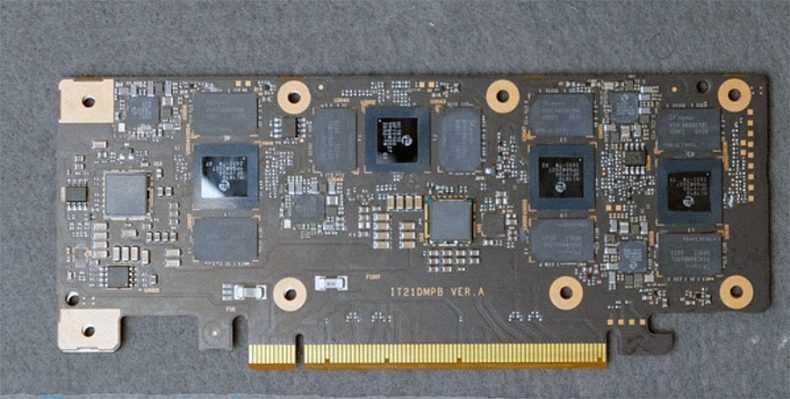
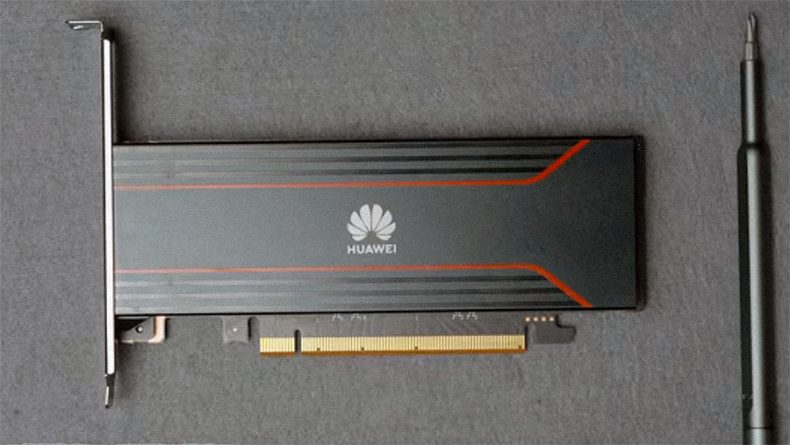
What makes it compelling for home lab builders is its power efficiency and form factor. The card operates at a modest 150W TDP, a fraction of the power consumed by high-end consumer GPUs. It also comes in a compact, single-slot, full-length design, making multi-card configurations in a standard desktop or server chassis a practical reality. Imagine fitting two of these for 192 GB of VRAM without needing a specialized power supply or complex cooling.
What 96GB of VRAM Means for Local LLM Inference
The sheer amount of VRAM opens up possibilities previously out of reach for most home users. With 96 GB, running a quantized 70B parameter model with a full context window becomes straightforward. It even puts larger models, like the 120B parameter class, within reach of a single card setup. For those experimenting with Mixture-of-Experts (MoE) models, this card can hold very large models in memory, even if the lower bandwidth might impact the speed of activating different experts. This capacity fundamentally changes the scale of models that can be run without resorting to slower system RAM offloading or expensive multi-GPU setups with cards like the RTX 3090 or A6000.
Software Support and Performance
Hardware is only half the story; software support is what makes it usable. The Atlas 300I Duo runs on Huawei’s Ascend NPU architecture, which thankfully is not an entirely closed-off ecosystem. Crucially for the local LLM community, llama.cpp already has backend support for Huawei’s Compute Architecture for Neural Networks (CANN). This means there is a direct and established path to running GGUF models on this hardware. PyTorch also has support through a package called torch-npu.
While this is promising for inference, there are reports that some labs, like Deepseek, may have faced challenges using this hardware for large-scale training, suggesting the software stack may still be maturing. For the home enthusiast focused purely on running models, this is less of a concern.
That said, it’s important to note that the Atlas 300I Duo is not designed for regular mainstream PC motherboards. It is built specifically for Huawei’s Kunpeng servers and desktop motherboards based on the Kunpeng 920 processor. Making this GPU work on a typical consumer system can be challenging, and full compatibility may depend on future driver updates. Another caveat is that the card does not support Windows – it operates only under Linux, which limits accessibility for some users.
Early benchmarks show the card achieving around 15 tokens per second on a Qwen3 32B model, a respectable speed for a dense model of that size given the hardware’s profile. However, driver stability and ease of setup remain open questions that only wider community adoption will answer.
Price, Availability, and the Nvidia Comparison
The value proposition of the Atlas 300I Duo is impossible to ignore. Priced between $1,500 and $2,000 before shipping and potential import fees, it offers an unprecedented amount of VRAM per dollar. By comparison, a used RTX 3090 with 24 GB of VRAM goes for around $800—far cheaper, but with only a fraction of the memory. Similarly, Strix Halo mini PCs with 128 GB of shared memory can be found for around $1,700, offering a different balance of performance and capacity.
So, the choice is not so clear. Each processor on the GPU is limited to 204 GB/s bandwidth, which is quite slow. If your primary bottleneck is VRAM for loading massive models, the Atlas 300I Duo still presents a compelling, budget-friendly alternative. It is not an RTX 5090 replacement for high-speed inference, but it is a VRAM barrier-breaker for running the larger models of the open-source world.
Despite the slow memory speed, it also marks a strong starting point for China to build upon in future GPU development.


Leave a Reply
No comments yet.