
Meta’s Muse Glimmer 30B has been getting attention in local inference circles, and we wanted to know what it actually takes to run it on your own hardware. This article is not a review of the model’s reasoning or coding quality. We are strictly looking at hardware behavior. VRAM usage, context scaling, prompt processing speed, and token generation speed. The goal is simple: understand what hardware you actually need to run this model locally without guesswork.
All benchmarks were run on Ubuntu 24.04 with CUDA 13, NVIDIA driver 595.58.03, and llama.cpp build 153d324bc.
What Muse Glimmer 30B Is
Muse Glimmer 30B is a dense 30B class model, with 27.85B active parameters at inference. That puts it in the same size bracket as Qwen3.6 27B, which also sits around 26.90B parameters. Because both are dense models, the comparison between them is straightforward, unlike comparing against a Mixture of Experts model where only a fraction of parameters are active.
Our tests use the Q4_K Medium GGUF quantization. At this quantization the model weighs in at 14.78 GiB on disk, which is noticeably smaller than Qwen3.6 27B at 16.39 GiB for the same quant level. That size difference carries over directly into VRAM usage.
VRAM Requirements by Context Length
VRAM is the primary constraint for any local setup, and Muse Glimmer 30B scales cleanly with context length.
| Context Length | VRAM Requirement (GB) |
|---|---|
| 4k | 16 |
| 8k | 16 |
| 16k | 16 |
| 32k | 16 |
| 64k | 17 |
| 128k | 18 |
| 256k | 20 |
The number that stands out here is 256k context at only 20 GB of VRAM. That is a full quarter-million token context window fitting on a single 24 GB card with 4 GB of headroom to spare. For a dense 30B model, this is unusually efficient, and it is the main reason this model is worth a closer look if you care about agentic use and long-context local work.
What GPU for Muse Glimmer 30B
For Muse Glimmer 30B, a single 24 GB GPU is enough to cover the entire context range the model supports. Cards like the RTX 3090 or RTX 4090 can load the full 256k context and still have room left over. There is no need to go multi-GPU just to unlock long context on this model.
A 32 GB card such as the RTX 5090 does not buy you more context headroom here, since 20 GB already covers the maximum window. What it buys you instead is raw speed, which shows up clearly in the benchmarks below.
Unified memory systems, such as the NVIDIA GB10 platform we tested, are also capable of running this model, though at noticeably lower throughput than discrete GPUs. This is worth knowing if you are considering a unified memory box as a low-power always-on inference machine rather than a speed-focused rig.
RTX 3090 Performance Results
The RTX 3090 continues to be one of the best value cards for local inference, and it handles Muse Glimmer 30B well across the entire context range.
| Context | Prompt Processing (t/s) | Token Generation (t/s) |
|---|---|---|
| 4k | 1476.98 | 45.30 |
| 16k | 1364.44 | 44.49 |
| 32k | 1270.14 | 43.84 |
| 64k | 1098.35 | 42.45 |
| 128k | 852.85 | 38.13 |
| 256k | 584.38 | 35.46 |
Token generation stays remarkably stable across the range, dropping from 45.30 tokens per second at 4k down to 35.46 tokens per second even at the full 256k context. Prompt processing declines more noticeably at long context, but generation speed, which matters most for interactive use, holds up well.
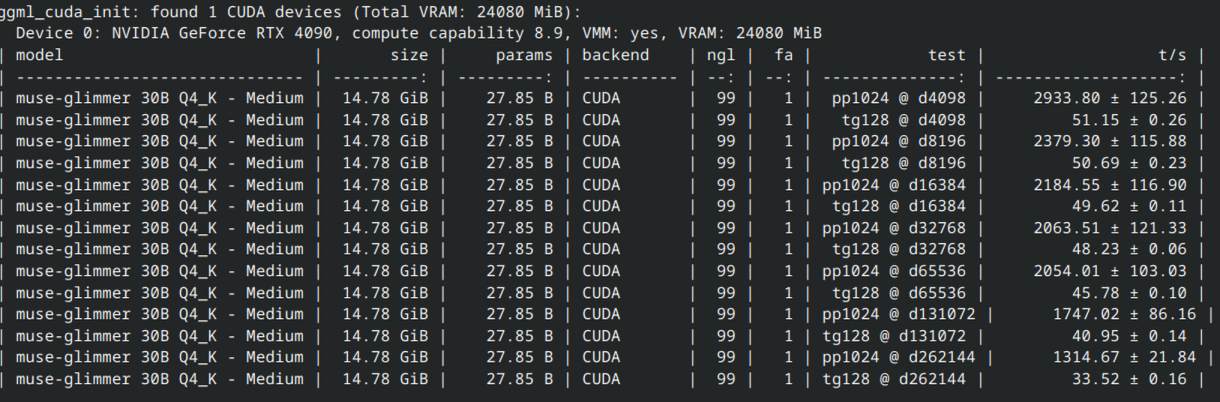
RTX 4090 Performance Results
The RTX 4090 sits between the 3090 and 5090 in this lineup, and the numbers reflect that.
| Context | Prompt Processing (t/s) | Token Generation (t/s) |
|---|---|---|
| 4k | 2933.80 | 51.15 |
| 8k | 2379.30 | 50.69 |
| 16k | 2184.55 | 49.62 |
| 32k | 2063.51 | 48.23 |
| 64k | 2054.01 | 45.78 |
| 128k | 1747.02 | 40.95 |
| 256k | 1314.67 | 33.52 |
Prompt processing on the 4090 is close to double the 3090 at short context, and token generation holds a similar advantage until context gets very long, where the two cards converge somewhat.
RTX 5090 Performance Results
On the RTX 5090, Muse Glimmer 30B is very fast for a dense model. Prompt processing at 4k context exceeds 4600 tokens per second, and token generation sits above 83 tokens per second.
| Context | Prompt Processing (t/s) | Token Generation (t/s) |
|---|---|---|
| 4k | 4624.93 | 83.22 |
| 8k | 4531.37 | 82.52 |
| 16k | 4373.80 | 82.84 |
| 32k | 4092.53 | 81.84 |
| 64k | 3606.35 | 79.69 |
| 128k | 2806.67 | 75.77 |
| 256k | 1874.17 | 68.98 |
What stands out is how flat the token generation curve stays. From 4k to 128k context, generation speed barely moves, staying in the low 80s. Even at the full 256k context the model is still generating at close to 69 tokens per second. For a dense 30B model this is a strong result and makes the RTX 5090 a genuinely good match for long-context, high-throughput local use.
GB10 Unified Memory Results
We also tested on an NVIDIA GB10 unified memory system with 128 GB of shared memory. This is a very different profile from the discrete GPUs above.
| Context | Prompt Processing (t/s) | Token Generation (t/s) |
|---|---|---|
| 4k | 989.50 | 12.76 |
| 16k | 953.33 | 12.76 |
| 32k | 896.52 | 12.52 |
| 64k | 821.56 | 12.11 |
| 128k | 699.42 | 11.41 |
| 256k | 549.39 | 10.29 |
Token generation on the GB10 stays under 13 tokens per second across the board, roughly a quarter of what the RTX 3090 delivers. The advantage of unified memory here is capacity rather than speed. It is a platform to consider if your priority is running very large models or very large contexts on a single box with minimal power draw, not if you want fast interactive responses.
Comparison to Qwen3.6 27B
Qwen3.6 27B is the natural comparison point for Muse Glimmer 30B, since both are dense models in the same parameter range. We ran the same test suite on an RTX 5090 for a direct comparison.
| Context | Muse Glimmer 30B (PP / TG) | Qwen3.6 27B (PP / TG) |
|---|---|---|
| 4k | 4624.93 / 83.22 | 3873.80 / 75.57 |
| 16k | 4373.80 / 82.84 | 3485.89 / 72.81 |
| 32k | 4092.53 / 81.84 | 2941.09 / 69.45 |
| 64k | 3606.35 / 79.69 | 1957.43 / 63.66 |
| 128k | 2806.67 / 75.77 | 1179.94 / 54.58 |
Muse Glimmer 30B is faster than Qwen3.6 27B at every context length we tested, in both prompt processing and token generation. The gap is modest at short context but widens considerably as context grows. At 64k, Muse Glimmer is processing prompts nearly twice as fast as Qwen3.6 27B. At 128k, prompt processing is more than double.
The file size difference tells a similar story. Muse Glimmer 30B at Q4_K Medium is 14.78 GiB, compared to 16.39 GiB for Qwen3.6 27B at the same quant level. That smaller footprint is what allows Muse Glimmer to load a full 256k context on a 24 GB GPU while using only 20 GB. Reaching similar context lengths with Qwen3.6 27B would require stepping up to a 32 GB card.
Early indications point to strong agentic performance for Muse Glimmer as well, though we have not independently benchmarked task accuracy or tool-use reliability, and those claims should be treated as unconfirmed until tested directly. From a pure hardware standpoint, though, the combination of lower VRAM use and higher throughput makes Muse Glimmer 30B an appealing base for long-context, agent-style workloads on a single consumer GPU.
Conclusion
Muse Glimmer 30B is a strong option for anyone running dense models locally. It uses less VRAM than Qwen3.6 27B at the same quantization, runs faster at every context length we tested, and fits a full 256k context window into just 20 GB.
A single 24 GB GPU, such as the RTX 3090 or RTX 4090, is enough to run this model across its entire supported context range. The RTX 5090 pushes token generation speed noticeably higher without needing more VRAM, since 20 GB already covers the maximum context. Unified memory systems like the GB10 remain an option for lower-power, higher-capacity setups, at the cost of significantly lower throughput.
For a price-conscious local inference build, Muse Glimmer 30B on a 24 GB card is currently one of the more efficient ways to get large context windows without moving to a multi-GPU setup.